Louisville resident Patrick Litanga was a case manager for Kentucky Refugee Ministries in 2015, and he was tasked with helping his clients resettle in the United States and find employment.
“I had the gentleman sitting in front of me…maybe in his mid-40s,” Litanga said. “One of my first questions for them was, ‘OK, tell me about your work history,’ because we're trying to figure out how they can work. And then the gentleman tells me, ‘I am a gold digger.’”
The man had worked in gold mines since he was 12 years old, Litanga said. He said the story reminded him of the gold mines in Kilo-Moto, a northeastern region of the Democratic Republic of Congo, where Litanga is from.
Litanga took notes about his interactions at KRM. Over time, the ideas he captured inspired dozens of poems and essays he wrote about the lived experiences of refugees in Kentucky.
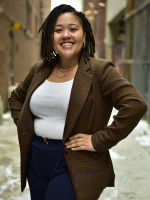
In “The Road to Kilo and Other Places,” Litanga shares stories about Louisville refugees through poetry and other literary works. KRM’s communication manager and artist Alexandra Miniard added illustrations to bring the stories to life.
A fragmented home
Miniard said she started working on the drawings in 2022, and found the early works “deepened her connection” with the clients who told her their stories nearly every day.
“The more you hear those stories, the more you realize how much you have in common, or how human they are there,” she said. “We're all not that different at the end of the day.”
The stories reminded Litanga of his own experiences as a KRM refugee several years ago, he said. As the collection grew, two themes emerged: home and fragments.
“As you grow and as things happen to you, as a relationship changes, your idea of home begins to change,” Litanga said. “At some time, we all have a fragmented past, and we have to decide what to do with those fragments. Relationships change. Jobs change. Things happen. Responsibilities shift.”
Miniard focused on those emotions in her drawings. She said she often took on some of those heartbreaking feelings during her work.
For her, these experiences are universal.
“I think whether you're looking at your own experience or even through your history, what your family might have gone through,” she said. “For a lot of us in this country, our ancestors, our family, fled something. I'm in part from German Jews, and they fled oppression and persecution. We will be wise to not forget that, and to realize that there are these similarities for human beings that stretch throughout our lives and our family's lives.”
While some of the stories are heartbreaking, Litanga said a few of his poems came from moments of joy. He described the moment he met a client from East Africa who inspired his poem “A Dignifying Man.”
“He always has this beaming smile coming out of his face,” Litanga said. “He’s a guy who, even if he's going through a hard time, he sees you. He dignifies you. ”
Miniard said this is one of her favorite illustrations.
“I was working on the smile on his face, and I would smile and think about the story. How can you not feel uplifted when you know that someone who has gone through so much they're not weighed down to such an extent that they can't go on, that they don't have that hope?” she said.
Each piece required in-depth research, Miniard said, and she relied her background in anthropology to depict certain cities, nationalities, ethnicities and moments in history in her work.
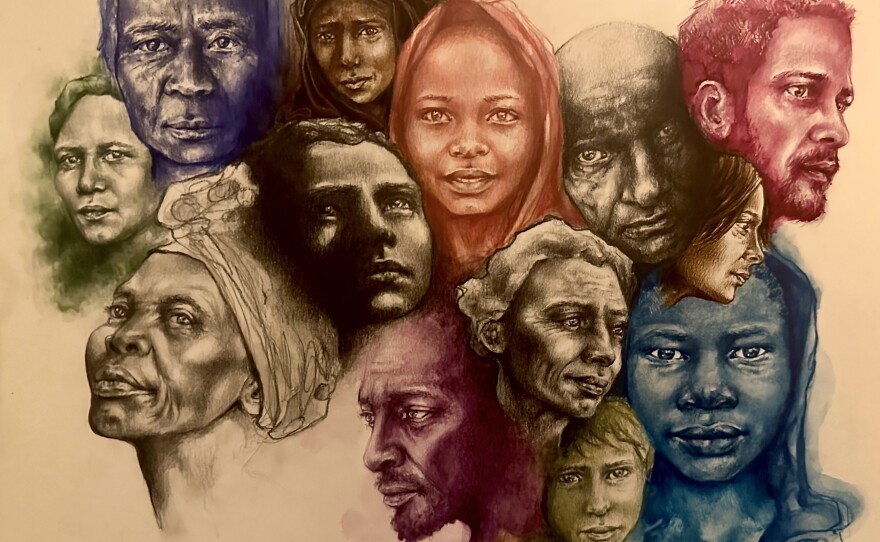


“We wanted to include a lot of diversity to really represent the broad spectrum of forcibly displaced people,” Miniard said. “So while maybe initially that had been from a different voice, we wanted to ensure that people were represented, that there was a lot of visibility across the globe.”
Pushing back
Miniard said the illustrations are not real portraits of clients to protect their privacy.
The collections come amidst a nationwide immigration crackdown. Earlier this month in Louisville, some immigrants from the Democratic Republic of the Congo, Burma, Cuba and Rwanda were turned away from the citizenship ceremonies. These and 15 other countries are among the list of “high risk” countries, according to the Trump administration.
To Miniard, her art and Litanga’s writing is an “act of resistance.”
“I think anything that we can put out in the world as artists, to help humanize people, and to help people feel seen and feel heard, to have those voices out there, and to hopefully have those experiences resonate with somebody, I think is really important right now,” she said.
Litanga said his work further supports refugees and immigrants in the U.S.
“What has become really important for us is this contribution that immigrants have been putting in this country that is basically now neglected or under-appreciated,” Litanga said.
Miniard and Litanga are looking for a publisher for their collection. They said they hope to do a book tour and create a theater production of their work.