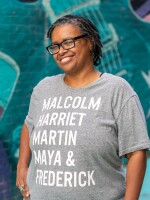
A History and Science forum in Louisville will bring together leaders from both backgrounds to explore how they intersect. It’s part of a series hosted by the University of Louisville Christina Lee Brown Envirome Institute.
Natasha DeJarnett is an assistant professor of environmental medicine at U of L. She helped organize the event, and joined me to talk about the series.
This conversation has been edited for length and clarity.
Michelle Tyrene Johnson: Tell me about the focus of the Christina Lee Brown Envirome Institute.
Natasha DeJarnett: The Christina Lee Brown Envirome Institute is out of the Division of Environmental Medicine at the University of Louisville. Our center fills a void through our framework to understand the environment as a whole, through our interactions between the natural, the social, and the personal domain. So, natural can include everything that's not man-made. Social can include how we organize ourselves into society and how we build communities, and the personal is the lives that we build for ourselves.
So looking at all of those domains that are all-encompassing of the environment, we seek to understand how the environment increases or decreases risk of developing heart disease, for example, and we utilize the understanding of the environment's specific domains on health to inform that.
MTJ: So you're the organizer of an event coming up, and it’s part of what sounds like a really interesting series.
ND: This is something that we are really excited about. I returned to University of Louisville in January of last year, and I was handed our strategic plan for our institute. And within the strategic plan, under community engagement, was a goal to host quarterly forums. So we began thinking about what these could look like, and out from that was born the idea of “& Science.” So “& Science” is meant to look at areas that seem like they are distant from the environment that actually are very interconnected, so that people can see themselves in all of these spaces.
Our first event was “Communication & Science,” and we had this in September of last year. We featured environmental reporters and environmental communications experts throughout the city, and we brought together those experts in a panel to discuss the current state of affairs when it comes to communications and the environment. And we also used this opportunity to celebrate community heroes, and then we also utilized that time to showcase some community resources and community organizations. We had a community organization fair and a reception that led into the award presentation and the amazing panel. So that was our first event, and it went amazingly well. There was a lot of positive feedback, and from that, we continued to build on it.
Our most recent event was “Faith & Science.” That was the second installment of this series, and we had faith leaders that care about the environment, and we had environmental leaders, who were people of faith that represented different faiths, to come together from different vantage points and share about this intersection of faith and the environment and even envision a brighter future for faith and the environment. So that was exciting and wonderful. Now we have a “History & Science” event that is coming up really quickly.
MTJ: Is there a particular segment of the community that you're focused on in this conversation?
ND: We're focused on all of the community in this conversation. I've struggled with this when people have asked me in the past, who's the primary audience. Hopefully, everyone, because by the interdisciplinary nature of these programs, where it's communications for one installment, it's faith for another, it's history for this one, we want everybody to be able to see themselves in different parts of the conversations as they continue to evolve.
For this particular conversation, we're going to look at those intersections of history and science. We're going to put a snapshot locally on environmental history here in Louisville, how that has transformed and how that has changed course, and we're looking at it through different vantage points. So we have a cultural strategist on this panel. We have two medical archivists on this panel, one is able to explore through health disparities, and the other is able to explore through certain health conditions that have plagued Louisville. I'm trying not to give too much away from the conversation, but we also have policy expertise.
So that is the point, that I want everybody to be able to see themselves in this space. I've not reached out to anyone who said, “I don't have the right expertise for this,” because all of the different, unique voices beautifully populate this conversation. We are very interested in the artistry that Hannah Drake offers through her experiences as a cultural strategist to inform this conversation, the observations that she's gathered on justice and social justice here within the city. We have Dr. Monica Unseld, from Until Justice Data Partners, who has done amazing work in data advocacy and even provided recommendations to presidential administrations. We have people that are bringing different aspects into this conversation, but all are affected by history, whether that's historical data, whether that's historical policy, whether that's historical medical mysteries, and unique medical situations. It all adds to the conversation.
The thing is, here in Louisville, we have a very interesting story to tell, and so finding the group of people to help have this dialogue and form this discussion was easy. What we have here in this session is a dream team.