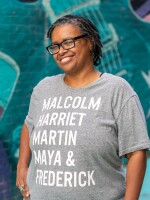
In late November, Dr. Kelly McCants, a prominent Louisville heart doctor and health equity advocate, died at the age of 50. Condolences poured in, including from Gov. Andy Beshear and Louisville Urban League President Lyndon Pryor.
Russ Cox, Norton Healthcare CEO, spoke with LPM's Michelle Tyrene Johnson about McCants’ work addressing health care disparities, and how his legacy will continue.
This conversation has been edited for length and clarity.
Russ Cox: Kelly McCants was the most unique individual that I've ever had the opportunity to interact with in my career in health care. The importance of his work was a confluence of times that were different in health care and times that we needed someone like him the most. I came to know him when we recruited him to lead our heart failure program at Norton Healthcare in 2018, and it was one of those recruitment efforts that you felt like, well, this ought to be easy. This is a gentleman who went to Meharry [Medical College], [did his residency with] the University of Louisville School of Medicine, had worked here locally in health care, and then somehow Atlanta stole him from us. I'm talking about a unique point in time to have a Black cardiologist who specializes in heart failure. There were probably three of him in the world. There weren't many at all. What we didn't realize was that there were a lot of people talking to Kelly at that time. He brought such an interesting mix of clinical expertise and emotional intelligence, and had an understanding of the plight of the heart failure patient that also told me very quickly he understands health equity in a completely different way than anybody else does.
Michelle Tyrene Johnson: I can only imagine that as a Black man and as a Black man who specialized in health care, heart health care, he really had a unique perspective.
RC: One of the things that Kelly never allowed was that acceptance that your life does not have to be determined by this. And there was such a feeling of futility amongst heart failure patients that their inevitability was death.
MTJ: When he passed away, my Facebook feed was just flooded with condolences and with shock and dismay. There were several patients who talked about how he helped save their life. Do you feel that his emphasis on health equity allowed more people who don't typically have access to quality medical care to get the care that they needed?
RC: Absolutely, I've had conversations with a lot of his ventricular assist device patients through the years, and he immediately started in a place in the relationship where there was no judgment. And how that would manifest itself many times was a patient would come in and say, “look, I smoke, I drink, I don't eat right and I'm not going to change.” And instead of lecturing these individuals, Kelly built a bridge with them to say, well, let's talk about why you do those things, and let's talk about how we can help you understand a different life without those things.
That connection was really the differentiator for him, and part of it was because he knew it firsthand. He had grown up in a neighborhood where there was a lot of futility. He had the emotional intelligence that blended with that MD in a very unique way that really spoke to him being able to bridge gaps on health equity as well. One of the most emotional times I ever had with Kelly was when we first got the community report on health equity in our community, and the statistic that we saw that basically said from one ZIP code to the other in Louisville, Kentucky, your life expectancy is about 15 years difference, and there's only about 20 miles difference in those two ZIP codes. And it was like, this is unbelievable, and the passion that was brought to both of us from the standpoint of we need to understand this better, and as we got deeper into it, we realized access has everything to do with that, but also trust. That was a big, big difference.
In Kelly, he was able to build trusting relationships with patients to the point where they would tell them things they wouldn't tell anybody else, and then they wanted to change for him. They wanted to have a better life. A physician that's able to get you to change your behavior on your own and really take control of your own health status is really unique.
MTJ: With him being so unique in terms of how he could relate to so many patients, especially underrepresented demographics, how does that carry on with him gone?
RC: Well, his legacy has to continue. It's just that simple. We've made great progress from a health access standpoint, with the first hospital built in 150 years west of Ninth Street. Corenza Townsend's fingerprints are all over that, but Kelly McCants' fingerprints are all over it, too. So having this place where we can connect and build trust in a different way continues his legacy.
One of Kelly's greatest contributions was that he mentored extremely well. Younger physicians coming up who want to continue this trusted him, sought out his advice. Of many current physicians who are in cardiology, especially minority physicians, Black physicians, I'd venture a guess that he's touched them in some way along the way. He was always willing to take the time. He was always willing to have people come into the clinic and learn, so that legacy really was something that he started that we must continue. We must continue to build on it. And that comes in the form of continuing access, that comes in the form of getting the right people who have that emotional intelligence, and that comes from being consistent with those patients.